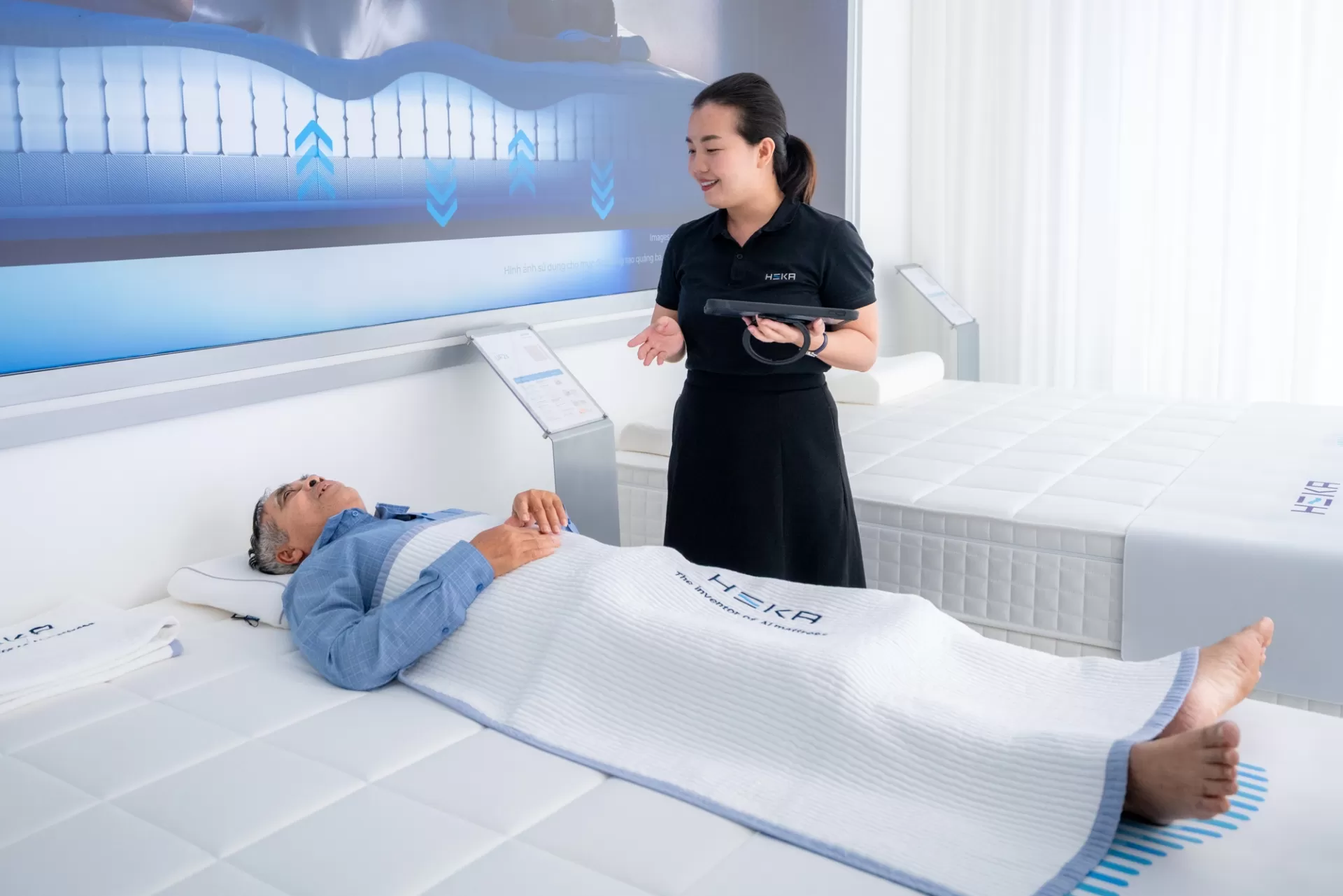
A traditional mattress is made of materials. The HEKA AI Mattress carries an AI sleep ecosystem: Bio-Motion sensors and the TrackR AI chip, which drives the aerodynamic support system with the Cloud-Motion algorithm. Scroll to take the layers apart and look inside.
6 layers working together
Each layer has its own role
From the surface fabric to the AI support columns, six layers work as one closed feedback loop: the sensors measure pressure, the AI core analyzes it and gives the command, and the support columns fine-tune each region.
01Surface fabric
02Comfort quilting
03Comfort & pressure layer
04Bio-Motion sensors
05All-in-One AI core
06AI support columns
04 · Bio-Motion sensors
Senses every movement
The Bio-Motion pressure-sensing membrane lies right above the support columns and measures the body's pressure distribution in real time. From that pressure map the system recognizes body shape, posture and even the micro-movements of the shoulders, lower back and hips, then passes the data to the AI core.
Pressure map
Posture
Micro-movements
06 · AI support columns
Ultra-quiet fine-tuning
Elastic polymer columns with high tensile strength rise and lower independently for the shoulders, lower back and hips, helping to keep the spine in a neutral position. When the posture changes, the support is fine-tuned within 10 milliseconds.
Elastic polymer
Adjusts by zone
6.3–9.6 cm travel, by line
Supporting posture: on the back
05 · All-in-One AI core
Inside the brain of the mattress
Two modules at the foot of the mattress, packed in a metal housing (All-in-One) that shields electromagnetic interference. Lift the lid and you find the HEKA TrackR chip and the ultra-quiet aerodynamic system that raises and lowers the AI support columns by zone; the whole system runs on a safe 12V DC supply.
HEKA TrackR chip
Aerodynamic system
12V DC
05 · HEKA TrackR AI chip
The heart of the system
The HEKA TrackR AI sleep chip recognizes body shape and posture from the Bio-Motion data in 3 milliseconds with the Cloud-Motion algorithm, checks it against the Stanford–iFutureLab Sleep Medicine Database and commands the AI support columns, right inside the mattress, with no network connection needed.
TrackR AI Sleep Chip
Cloud-Motion
Stanford–iFutureLab
01 – 03 · Material layers
Three material layers above the AI core
The AI core now sits inside the base frame. Above it are three material layers: breathable surface fabric, quilting that absorbs and releases moisture, and a comfort layer that spreads pressure evenly before it reaches the sensors and the columns.
Every material layer returns to its place, forming one solid mattress for deep, restful sleep.
Scroll to take it apart
This browser is not using the graphics card (hardware acceleration is off), so the model runs slower than usual.
Drag on the model to rotate · drag vertically to tilt
Loading the 3D model…
This browser cannot enable WebGL, so a still image is shown instead of the 3D model.
HEKA AI Core System
Whatyouhavejustseeninside
The HEKA TrackR AI chip, pressure sensors, the Cloud-Motion algorithm and the ultra-quiet aerodynamic system work together, so the mattress fine-tunes its support all night.
HEKA TrackR AI Sleep Chip
Directs the science behind every support adjustment of the AI mattress.
High-Precision Bio-Motion Pressure Sensors
High-precision, real-time pressure sensing across the whole body.
Cloud-Motion Algorithm
Recognizes body shape, sleeping posture and body regions to adjust seamlessly through the night.
Stanford-iFutureLab Sleep Medicine Database
Multimodal sleep support built on Stanford-iFutureLab research, updated over the air.
Ultra-Quiet Aerodynamic System
Works almost silently, so sleep is never disturbed.
HEKA Comfort Layer and Elastic Smart Columns
Silk, camel wool, pure cotton and highly elastic, durable polymer columns.
The 3D model shows the structure; the feeling of support only comes from trying it. A HEKA specialist welcomes you at the Sala showroom by appointment.